Ars Moriendi
Woodblock facsimile
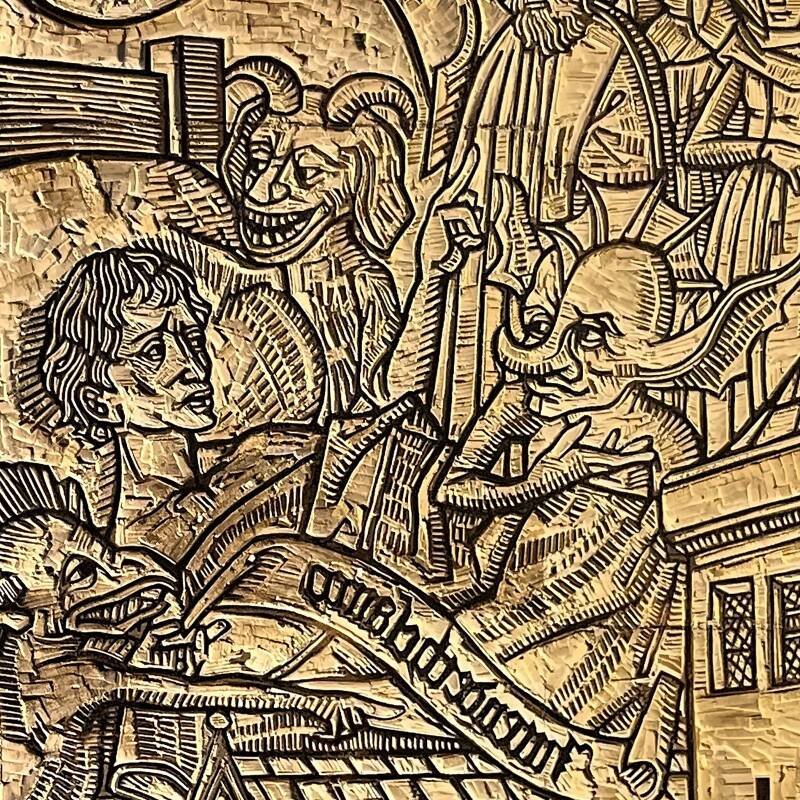
In 2025 I received an unusual commission: to make a facsimile of a woodcut from the Ars moriendi, a fifteenth-century book, for the collection of Emmanuel Pan.
What is the Ars moriendi?
Its name means “the art of dying well.” It is a manual to accompany the dying and one of the most widely circulated block books of its time: books whose images and text were carved in wood and printed on only one side of the paper. It shows a sick man in bed, besieged by demons who tempt him with doubt, despair, impatience, vainglory and avarice. In each image, angels defend him and answer the demons. The last scene is a peaceful death. The book was printed in several languages throughout the fifteenth century, and its images could be understood even when the text was in Latin.
The print I was asked to reproduce is the one about avarice: the sick man’s bed sits on the roof of his house, and a demon tells him “take care of your treasures” while pointing at his heir.
First challenge: how big was it?
As with every fifteenth-century block book, there is no single standard size: each impression varies slightly from one copy to another. After research with no conclusive results, I managed to obtain precise information from a copy held at the Library of Congress in Washington, D.C. The librarian Marianna Stell took the measurements and shared them with me so I could build the block.
The prints ranged from 21–22 cm in height and 16–17 cm in width. I understood then that historical fidelity did not mean a single exact figure, but working within a plausible range. On that basis I defined the scale of the block.
The block: eight pieces
I chose Palo Blanco for its stability, its tight grain and its excellent response to the burin. The image was not carved from a single block, but built from eight independent cuts that, assembled with millimetric precision, rebuild the visual unity of the original print.
It was a technical decision. Because of the format, the direction of the grain and the natural tension of the wood, dividing the support was safer and ensured stability and an even impression. Each section was planed, squared and calibrated before the drawing was transferred.
Carving the way it was done in the fifteenth century
The process was gradual and methodical: first the structural lines, then the large cleared areas and, finally, the internal modulations. The originals are outline prints, with a thick and a thin line and only very simple shading, often meant to be colored by hand. Rather than copying outlines, I wanted to recover the logic of the graphic system: the relationship between black and white, the density of the line and the visual rhythm of devotional woodcuts.
The proof and the printing
The state proof confirmed that the chosen scale worked: the image had the compactness and presence of the historical copies. I could not compare it physically with the original, and perhaps that was for the best, but next to the available reproductions the match was convincing.
The final printing sought a balance between pressure, ink load and the definition of the carved whites. The result is a print with firm contrast and clear structure, consistent with the didactic and severe character of the Ars moriendi.
From the workshop to the Palacio Barolo
In 2026 the work was exhibited at the Hören studio, in the Palacio Barolo (Av. de Mayo 1370, 9th floor, office 242, Buenos Aires), a building inspired by Dante’s Divine Comedy and by the journey between life and what comes after. It is now part of Emmanuel Pan’s private collection.
This project was also an exercise in material archaeology for me: understanding how an image was built in the fifteenth century, accepting variability as part of its nature, and recognizing that fidelity is not mechanical exactness but structural coherence.